
October 7, 2026
The Apocalypse Comes With a Fuel Discount
8 views · Counting since 7 Oct 2026
International Affairs, Unfortunately · The week of September 30–October 6, 2026
I would like to unsubscribe from world events. Unfortunately, the unsubscribe button appears to be in the hands of a man who thinks nuclear annihilation is material for crowd work.
This week offered American disaster banter, Germany testing the structural integrity of its political firewalls, and Brazil ordering another helping of a family drama nobody needed renewed. Somewhere, a sensible person suggested dealing with the actual problems. Presumably security escorted them out.
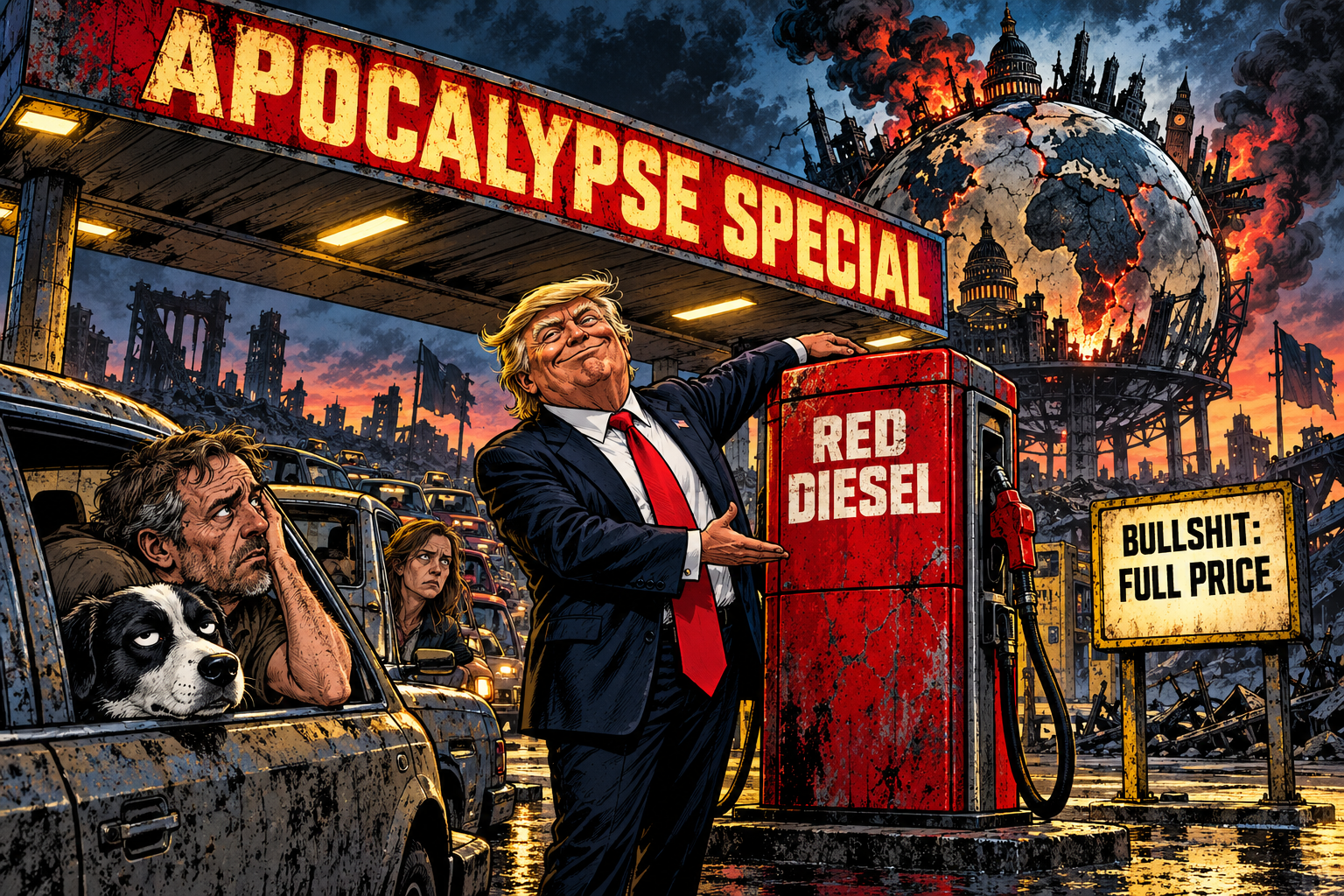
America: would you like the apocalypse with a discount?
At his October 5 rally in Nebraska, Trump discussed Iran’s nuclear threat and the costs of war, then said: “Let ’em take out Los Angeles, let ’em take out San Diego.” The White House’s defence was that he was describing dangers he had prevented, not advocating an attack. Reuters reported the remark and the backlash.
Ah. Reassurance. Traditionally delivered without naming two of your own cities as potential write-offs.
If your pilot announces that losing the left wing would be a small price to pay, you do not applaud his refreshing honesty. You start looking for the emergency exit. Apparently the presidential version requires a spokesperson to explain that, actually, the wing situation is going beautifully.
Los Angeles and San Diego are places where people live. They have children, kitchens, appointments and dogs who need walking. They are not disposable scenery in a rally anecdote. You do not get to reduce millions of lives to a punchline and then act wounded when the audience fails to appreciate your timing.
But there was also a fuel offer. Trump’s October 5 order directs temporary penalty relief for highway use of red-dyed diesel and conditional deferral of certain federal diesel taxes through December 31. Deferral is not permanent tax forgiveness; the order separately calls for exploring that. The executive order is here.
So that is the week’s package: existential dread, with savings at the pump.
I am delighted that someone remembered affordability. It would be even nicer if the promotional material did not leave me wondering whether the destination will still exist when I get there.
Germany: the firewall has a visitor entrance
In Saxony-Anhalt, AfD politician Tobias Rausch became president of the state parliament on October 6. BSW backed him; Die Linke opposed the development. His 48 votes exceeded the combined AfD–BSW total by four. The ballot was secret, so those extra voters are not established. The AfD still faces obstacles to forming a state government. Reuters covers the government impasse. DPA reports the vote and Die Linke’s response.
A firewall is supposed to stop something getting through. Germany’s political version increasingly resembles a nightclub rope: firmly closed, unless someone knows the doorman.
The extra four votes are quite the little parliamentary mystery. Four anonymous contributions to a historic breakthrough, with none of the inconvenience of putting your name on the gift card.
BSW, incidentally, is not Die Linke. Political parties may split, rearrange and rename themselves, but we should at least put the correct label on the box before discussing what escaped from it.
Berlin: solidarity, subject to terms and conditions
Meanwhile, Die Linke won Berlin’s September 20 election with 25.7%. That is an election victory, not a completed takeover of city government: talks with SPD and the Greens remain preliminary. This past week, the dispute over antisemitism and Israel-related positions in parts of the party continued to obstruct the route to a coalition. DPA describes the current state of the talks.
SPD and the Greens want clear action against antisemitism. Die Linke’s leadership rejects the accusations against the party and pledges to protect Jewish life. Critics point to rhetoric and activist appearances around the Berlin party; defenders argue that legitimate criticism of Israel is being smeared. Deutschlandfunk examines the coalition dispute. ZDF explains the allegations and the distinctions.
The dispute has concrete examples. DPA reports that activist Hannah Bruns faces a requested party-expulsion process after remarks including the claim that Palestinian liberation would extend to Tel Aviv. An open letter backing the Neukölln party calls for stopping that process. DPA sets out the controversy and the supporters’ position.
There is a considerable distance between demanding Palestinian rights and treating another population’s city as something to be reclaimed. Apparently that distance needs signposting inside the party aspiring to run Berlin.
Here is a radical administrative proposal: a party hoping to run a city should be able to explain, without a forty-minute seminar, how it will keep its Jewish residents safe.
Criticising the Israeli government is legitimate. Defending Palestinian lives is necessary. Neither requires a loyalty discount on Jewish safety. If your commitment to universal dignity develops a sudden exception whenever Israel enters the conversation, the word “universal” is doing unpaid overtime.
Nor does invoking antisemitism magically make every criticism of Israeli policy disappear. These distinctions matter. A functioning political movement ought to manage more than one moral instruction at a time. My washing machine has several settings, and it has never asked to become mayor.
Germany has managed to produce a week in which the right’s boundaries and the left’s principles both require inspection. Different problems, different parties, one exhausting expectation that voters will grade everyone on a generous curve.
I am tired of being asked to check the party logo before deciding whether something is unacceptable. The standard should survive a change of stationery.
Brazil: the sequel comes with the same surname
Brazil’s October 4 presidential vote sent Lula and Flávio Bolsonaro to an October 25 runoff. Flávio—the son, not former president Jair—finished ahead in the first round, roughly 47% to Lula’s 45%. Nobody secured the majority needed to win outright. Reuters’ results tracker gives the figures.
The surname has returned for another season. Political dynasties are remarkably durable products: when one edition becomes inconvenient, there is always another family member available in the same packaging.
Voters have every right to reject incumbents, demand change and decide for themselves. What depresses me is how often the menu of political renewal resembles an attic clearance. Here is something familiar. Here is its relative. Would you like either with a flag?
Brazil has a runoff ahead, not a settled presidency. Anyone presenting the first round as the final result should be made to sit quietly until they understand how rounds work. Preferably without a microphone.
The adults have left the group chat
The common thread is the expectation that the public will absorb the consequences while the political class supplies the performance. A reckless remark becomes a communications problem. A boundary becomes a negotiation. A principle becomes an awkward obstacle between a party and an office.
And we are supposed to watch the show, pick a team and pretend that applause constitutes oversight.
I would like boring competence. Answer the question. Explain the policy. Protect the people. Apply your principles even when your own friends find them inconvenient. It sounds modest until you look at the current recruitment pool.
Until then, keep your standards high and your expectations supervised.
The diesel may be cheaper. The bullshit remains full price.
This is a satirical editorial based on the reporting linked above. The week refers to September 30–October 6; Germany’s September election results provide the background to the current government-formation disputes.