
October 22, 2026
Corporate Hunger Games: Is the Exit a Farm in Sweden?
23 views
Over 100 applications. One human conversation. Global layoffs. Perhaps the next career move involves chickens and a corkscrew.
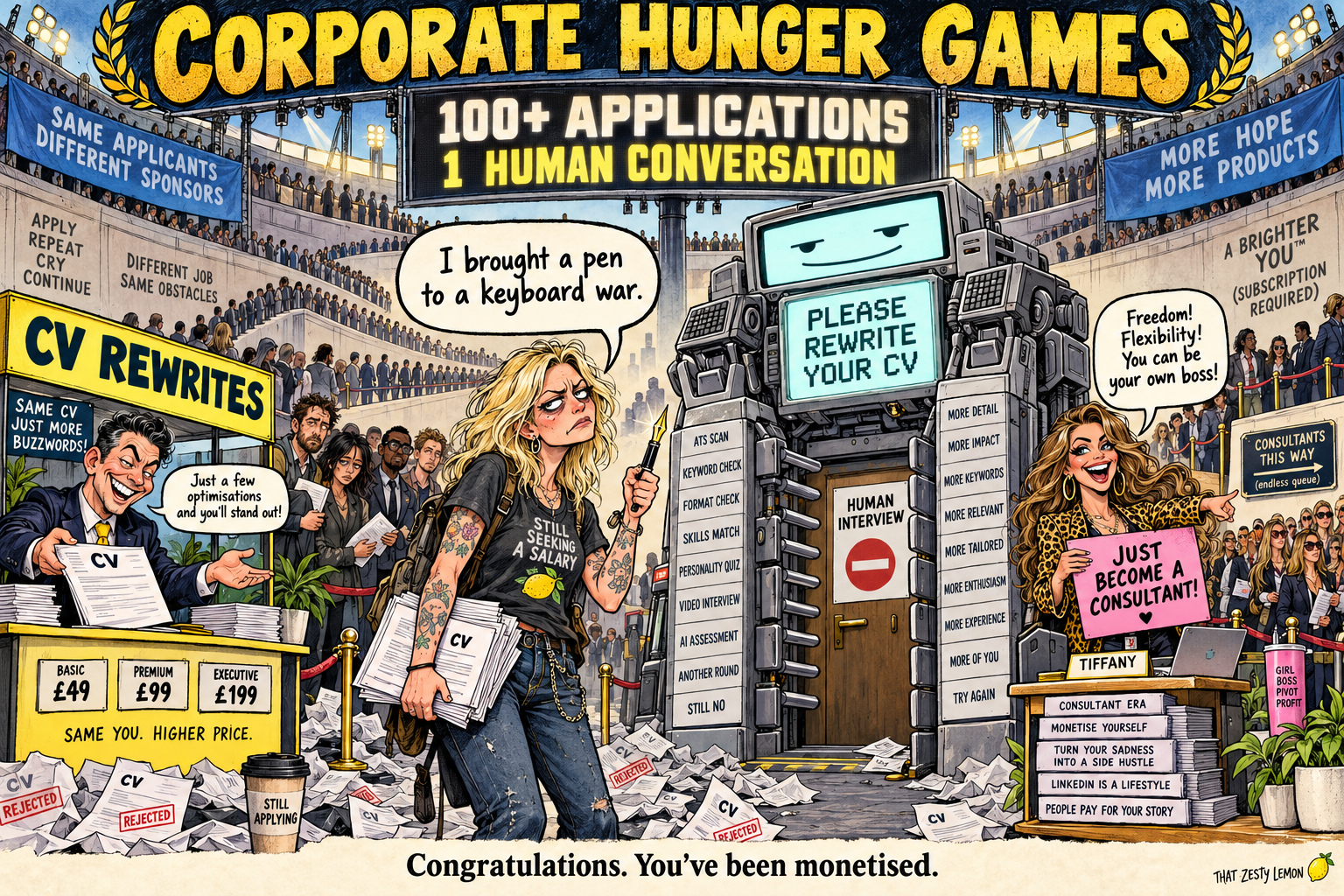
[Camera opens on a woman revising her CV. Again.]
Since June, I have applied for over 100 jobs.
This has resulted in one actual human interaction.
One.
At this point, getting a recruiter on the phone should unlock an achievement.
HUMAN CONTACT: LEGENDARY ITEM.
My CV has been revised approximately a hundred times. It has had more character development than most Netflix protagonists.
Shorter. Longer. More keywords. Fewer keywords. More personality. Less personality. Demonstrate leadership, but don’t look too senior. Show technical expertise, but don’t frighten anyone. Explain your achievements in numbers, preferably numbers that fit neatly inside a machine’s idea of a person.
I am apparently one formatting decision away from employment.
I have been one formatting decision away from employment since June.
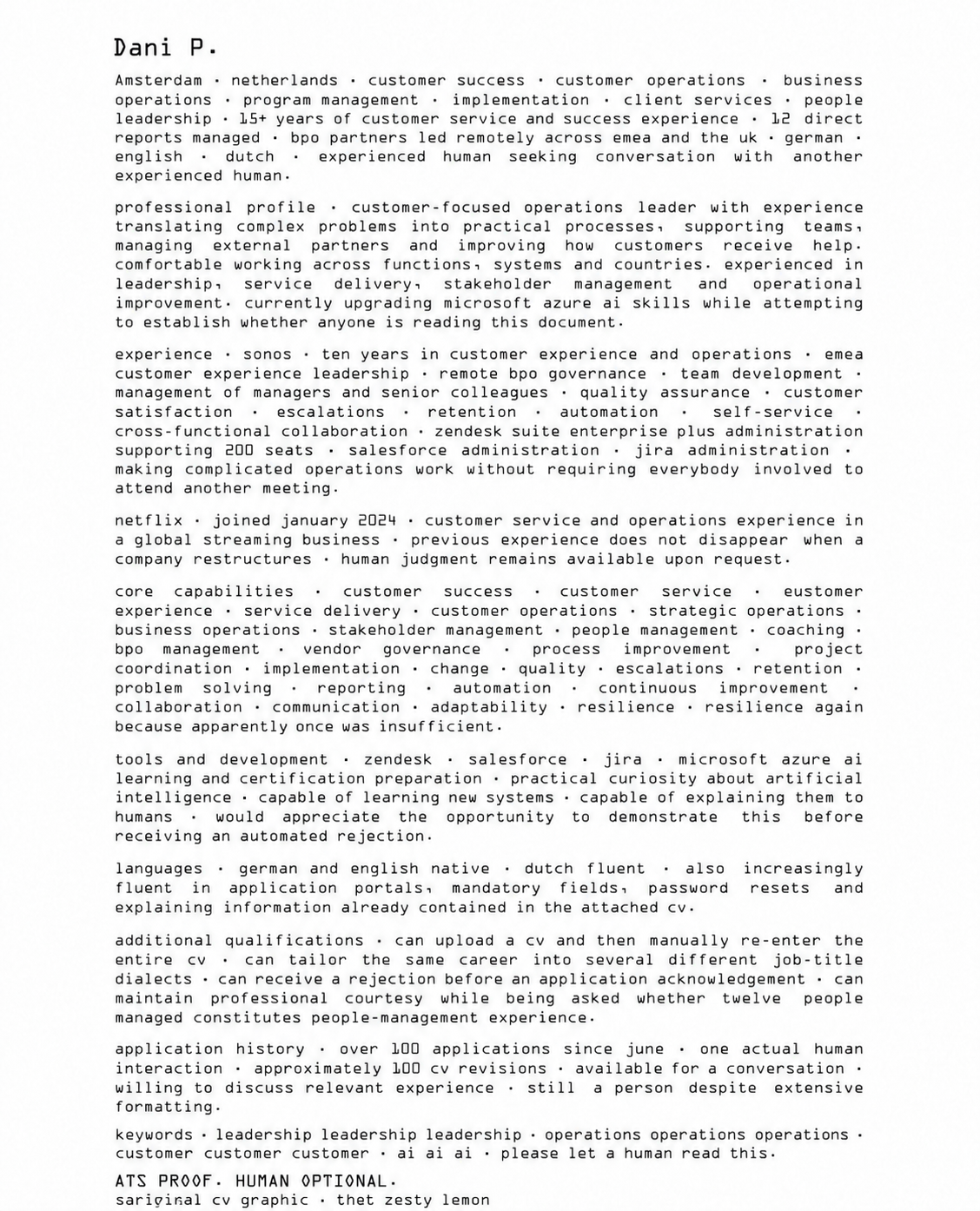
This week’s surprise contestants
My former employer, Netflix, has announced roughly 1,000 job cuts. A thousand people. Reuters puts it at around six per cent of the workforce.
My former boss is among those affected.
Which is horrible.
And because unemployment does unpleasant things to the inside of your head, my next thought was:
Great. More competition.
I hate that thought.
These are people losing security, income and colleagues. They deserve solidarity.
But the Corporate Hunger Games has arranged things so that you can feel terrible for someone while mentally calculating whether they’re applying for the same job.
There is blood in the water.
Someone has already launched a premium networking community for the sharks.
Then there’s Qualcomm. Reuters reports planned global job cuts, with notifications beginning in November. The scale wasn’t disclosed. I’ve heard the figure of 15 per cent of developers; that remains unconfirmed.
Even without a confirmed percentage, another layoff announcement is hardly the uplifting plot twist this season needed.
More people entering the arena.
Still no obvious increase in exits.
Apparently, the arena has gone international
Netflix. Qualcomm. And now Barclays, announcing around 5,000 job cuts this year. Different sectors. Different countries. The same dreadful moment when somebody’s livelihood becomes a line on a cost-saving slide.
This reaches well beyond my inbox. Reuters reports the Barclays cuts today, while its global layoff coverage documents companies cutting jobs as investment shifts towards AI.
That doesn’t mean every country, industry or employer is experiencing the same thing. The ILO projects broadly stable global unemployment in 2026, while warning that stable headline figures do not amount to healthy labour-market conditions.
But that is precisely why “the unemployment rate looks fine” can feel so disconnected from the experience of trying to get hired.
You can be qualified, actively learning, applying seriously—and still spend months trying to establish contact with the species responsible for hiring.
When layoffs keep arriving from multinational employers, perhaps we should stop treating every unsuccessful applicant as an individually defective product.
Perhaps another round of keyword polishing is a slightly inadequate response to a much bigger problem.
The Corporate Hunger Games has gone global. Unfortunately, the contestants are still being told to work on their personal brand.
Please upgrade yourself before being ignored
Meanwhile, I am upgrading my skills.
Microsoft Azure AI certifications. Courses. Studying. The expensive business of remaining relevant.
And I actually enjoy it.
I love playing with AI. Learning what it can do. Figuring out where it helps and where it produces something that sounds confident enough to chair a meeting while being entirely wrong.
I want to use these new skills.
Unfortunately, I cannot get far enough into a hiring process to discuss them.
I’m adding rooms to a house nobody will come and view.
“Have you considered upskilling?”
Yes.
“Excellent. Have you considered describing the upskilling differently?”
At what point do I get to meet the person whose approval I’m apparently redesigning my entire professional existence to obtain?
“Just become a consultant.”
Of course.
The emergency exit everyone keeps recommending.
Can’t find employment? Simply establish a business whose first requirement is finding people willing to employ you.
But individually.
Repeatedly.
With invoices.
I understand that consulting works for some people. I also understand that doing the work and selling the work are two different jobs.
I know how to run operations, solve problems and help teams function. I do not particularly want to spend my mornings knocking on metaphorical doors asking whether anyone has a moment to discuss their operational inefficiencies.
And apparently half the people outside those doors are also consultants.
We could form a queue.
Perhaps consult on improving it.
[Cut to Tiffany Hustleworth, standing beside a flip chart.]
“Welcome to my exclusive webinar: How to Not Be a Consultant.
“Module one: discovering that you wanted a salary.
“Module two: why having expertise does not automatically give you a burning desire to cold-message strangers.
“Module three: becoming a consultant to people who don’t want to become consultants.”
Early-bird pricing ends when Tiffany detects hesitation.
An exciting growth market: your unemployment
The strangest part is how much commercial activity surrounds the apparent absence of employment.
CV rewrites.
Profile optimisation.
Interview coaching.
Personal-brand packages.
Another tool to tailor your application to another tool.
Some services are useful. Some people are honest.
But from this side of the screen, it can feel as though the most accessible business opportunity is selling something to someone who needs a job.
I came looking for a salary.
Everyone keeps offering me a checkout.
Then there are the fake recruiters.
The ones whose interest in your career becomes remarkably intense around the point where they request identity documents.
Wonderful.
Even getting robbed now involves an application process.
“Congratulations, you’ve progressed to the next stage. Please upload your passport.”
I would rather upload my last remaining nerve, but the portal only accepts PDF.
Eventually, you start interviewing yourself
After enough silence, the question creeps in.
Am I the problem?
Maybe the CV needs work.
Maybe some applications were a stretch.
Maybe there are things I could explain better.
I’m capable of considering all of that.
But over 100 applications producing one conversation is a miserable amount of information on which to assess yourself.
There is no useful feedback. No discussion. No opportunity to discover whether someone misunderstood your experience or simply found a stronger candidate.
Just silence, occasionally interrupted by an email explaining that they were impressed.
Apparently, being impressed no longer requires meeting me.
How efficient.
And still you’re supposed to remain positive.
Show confidence.
Keep demonstrating resilience.
Resilience is becoming the skill employers most insist upon while providing an extremely thorough practical assessment.
I brought a pen to a keyboard war
I like AI.
I would quite like to discuss that with a human being.
Instead, I’m trying to make my experience legible to a hiring process whose workings I cannot see.
I don’t know which applications reached a person. Which were filtered. Which roles were paused. Which inbox is simply drowning.
That uncertainty is its own kind of exhaustion.
I can learn new tools. Earn certifications. Rewrite the CV again.
What I cannot do is demonstrate my value inside a conversation I’m never invited to have.
I brought a pen to a keyboard war.
Now someone is offering me a webinar on how to hold it.
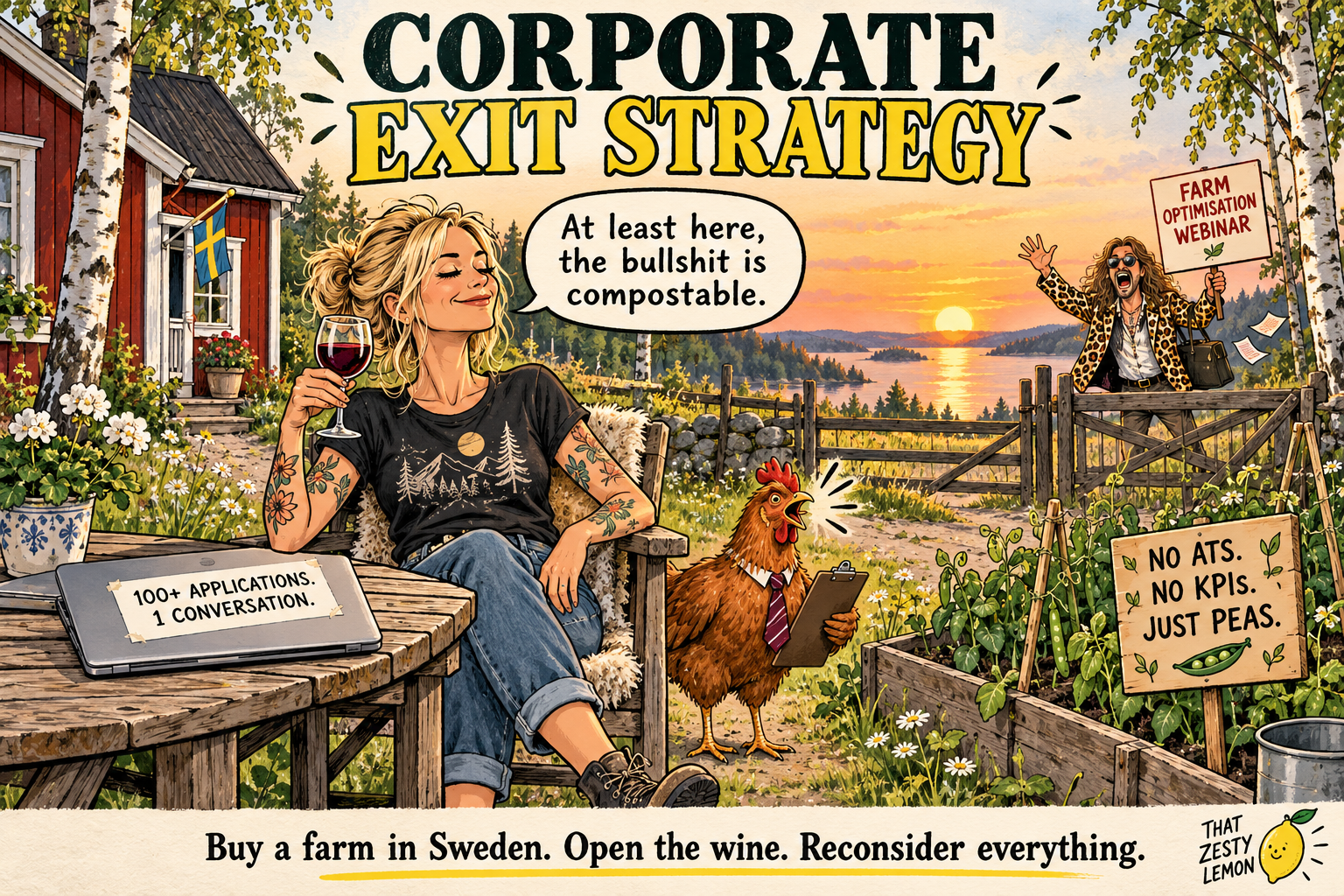
Perhaps the exit isn’t another corporate entrance
At some point, I have to ask whether the goal is still to get back into corporate—or whether I’ve spent months asking for a better seat on a ride I no longer trust.
I want to work. I like solving problems. I like learning things and making something useful happen.
I am less convinced that all of that has to involve a company that calls me its greatest asset until the quarterly presentation requires fewer assets.
Maybe the solution is to buy a farm in Sweden.
Grow something. Make something. Open the wine.
If there is blood in the water, perhaps I would rather be somewhere with a well.
Yes, farms involve hard work, bills, paperwork and things going wrong. I’m not confusing a mortgage with a spiritual awakening.
But if I’m going to shovel shit, I would appreciate being able to identify the animal responsible.
No ATS. No quarterly calibration. No chicken insisting I demonstrate executive presence before it lays an egg.
And if a hen rejects me, at least she’ll do it to my face.
I brought a pen to a keyboard war.
I’m beginning to think I should have brought a corkscrew.
Next time on Corporate Hunger Games: Tiffany launches Farm Optimisation for Former High Performers. The chickens decline her connection request.
Personal commentary and satire. Tiffany and her webinar are fictional. Sources: Reuters, October 14: Netflix announces roughly 1,000 job cuts; Reuters, October 20: Qualcomm plans global cuts, scale undisclosed. The 15 per cent developer figure is unconfirmed and is not established by these reports.
The Sunday Squeeze · Free weekly email
The world is ridiculous. Stay for the next episode.
The week’s best satire, cartoons and personal disasters from That Zesty Lemon. Delivered every Sunday, so you don’t have to trust an algorithm to find the next instalment.
Free. Unsubscribe whenever you’ve had enough. After signing up, check your inbox for the confirmation link—it may take a few minutes.