
October 22, 2026
Made in Germany. Approval Pending.
18 views
The industrial powerhouse would like a second chance. Please take a number.
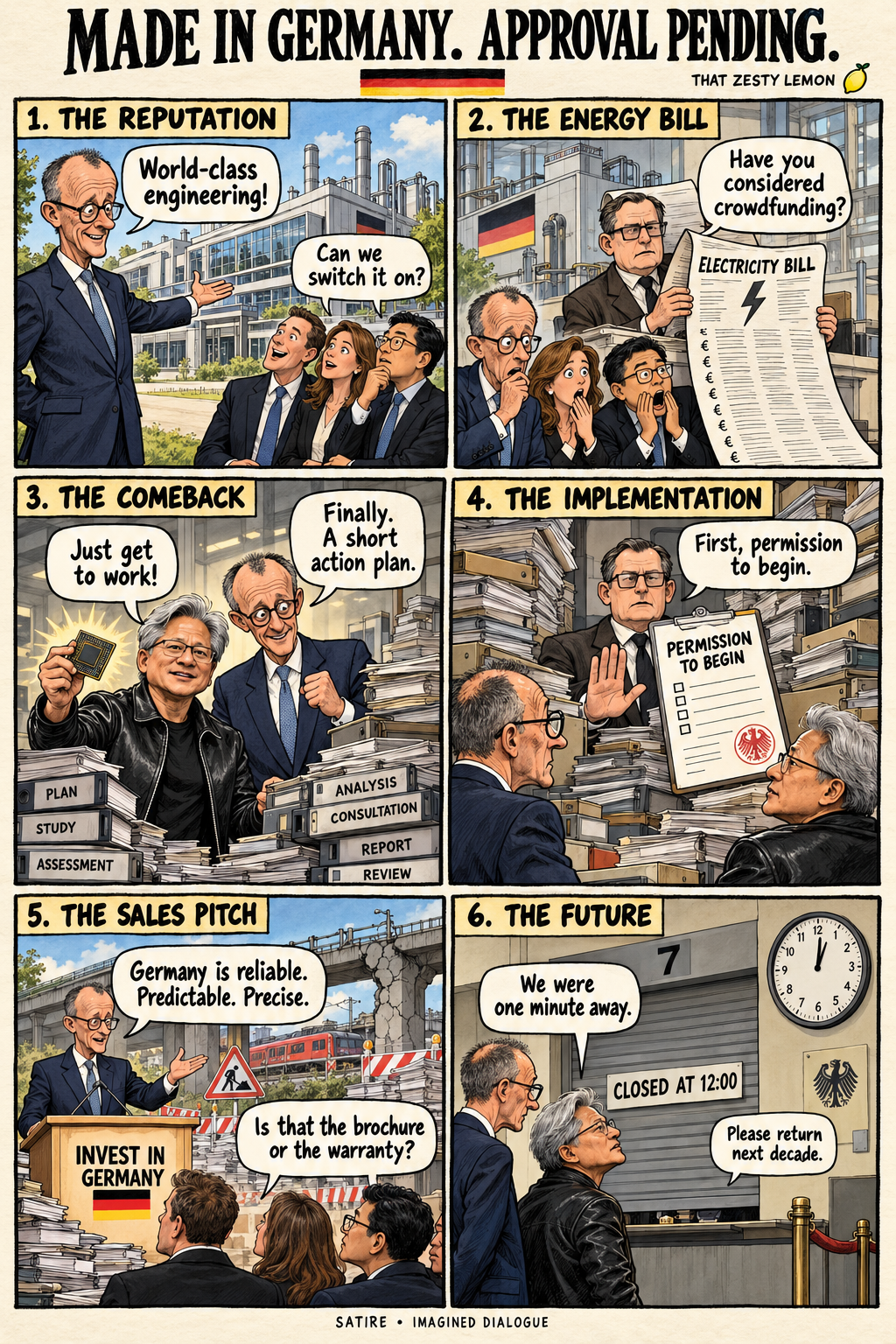
There was a time when “Made in Germany” did the selling for you.
Engineering. Precision. Machinery that would outlive your marriage and still have better service documentation.
Now Germany has to invite investors to a conference and explain that, underneath the electricity bills, administrative sediment and decades of deferred maintenance, there is still a rather good country.
Please invest.
We’ve put out biscuits.
The permit for the coffee machine is progressing nicely.
The factory is excellent. Switching it on may require financing.
Germany still has extraordinary engineers, manufacturers and researchers.
Which makes the current situation more infuriating.
This isn’t a country that forgot how to build things. It’s a country that has made building things feel like an administrative offence.
Want to expand a factory?
Excellent. Germany welcomes your ambition.
Please submit the environmental assessment, the planning application, the supplementary assessment of the planning application, and evidence that your proposed future is compatible with the municipality’s preferred past.
By the time permission arrives, your competitors have opened two factories and your original project manager has retired to Portugal.
Then comes the energy bill.
At which point the finance director starts researching whether the production line qualifies for asylum.
High costs and red tape are real pressures on Germany’s industrial base. Merz’s investor pitch explicitly promised faster approvals and better conditions. Apparently, making investment possible now requires an investment summit.
Unfortunately, I have developed sympathy for Friedrich Merz.
This is inconvenient. I had other plans for my personality.
But you cannot hand someone a house with leaking pipes, crumbling stairs and a fuse box labelled “probably fine, 1998,” then demand to know why the renovation isn’t finished after roughly a year and a half.
Germany’s problems did not arrive in Merz’s moving van.
Successive governments helped create this magnificent arrangement in which the country’s reputation kept working long after parts of its infrastructure stopped receiving sufficient attention.
His own political family doesn’t get to stand outside the wreckage wearing a visitor badge.
But neither can he repair decades of accumulated problems between breakfast and the next coalition negotiation.
Coalition government often looks like trying to renovate a kitchen with several people who agree the oven is broken but consider moving their favourite cupboard an attack on democracy.
Everyone supports the future.
Provided nothing important to them changes.
To be fair, there are major infrastructure and defence spending plans. The question is how much becomes functioning infrastructure and usable capability—and how quickly. A spending announcement cannot carry a freight train across a river.
Germany needs bridges.
It keeps producing sentences about bridges.
Enter the man selling the future.
Nvidia CEO Jensen Huang recently expressed dismay at Germany’s technological lag and offered some unusually compact advice:
“Just get to work!”
There it was.
A national modernisation strategy short enough to fit on the front of a folder. Naturally, we’ll need a larger folder once the implementation guidelines arrive.
The Nvidia partnership could help. The agreement aims to combine Germany’s industrial expertise with AI, which is considerably more promising than combining another task force with another PowerPoint.
But a chip partnership cannot, by itself, fix the conditions surrounding the chip.
You can buy the world’s most advanced computing hardware.
If connecting it to the grid becomes a generational project, you have purchased a very expensive monument to potential.
Also, Huang sells the equipment.
His concern may be sincere. His catalogue is conveniently available.
German punctuality: now a heritage product.
Then came Merz’s pitch about German reliability.
He invoked the familiar virtues: hard work, precision, dependable delivery dates. Even the national ability to secure a beach chair with a towel before breakfast made an appearance.
According to the account that prompted this piece, he arrived about ten minutes late before explaining that a German invited to dinner at six would turn up at five fifty-five.
If that timing is right, the joke was standing directly beside the lectern.
He only had to pick it up.
Sorry I’m late. Our reputation arrived at 17:55. The rest of us are still undergoing modernisation.
One small admission. A little self-awareness.
Because people can forgive ten minutes.
What becomes exhausting is being asked to applaud the punctuality while everyone can see the clock.
Please stop selling us the brochure.
I don’t want Germany to fail.
That’s why this is so bloody frustrating.
The skills are there. The industrial knowledge is there. The capacity to do something useful is still there.
But nostalgia has become a dangerously comfortable business model.
“Made in Germany” was a reputation earned by delivering things.
It cannot survive indefinitely as a reminder that we used to.
So yes: welcome investors. Build the AI capacity. Fix the energy problem. Repair the infrastructure. Make it possible for capable people to get something done before they lose the will to continue.
And when the country turns up late to its own comeback, acknowledge it.
Then get to work.
The future is waiting.
At counter seven.
Which closes at twelve.
Satirical commentary; imagined dialogue is fictional. The ten-minute delay and dinner-time anecdote are reader-reported and have not been independently verified.
Sources: Reuters: Merz’s investment pitch, costs and red tape; Financial Times: infrastructure and defence plans; Euronews: Huang’s criticism and the investment summit; Nvidia: the industrial AI agreement; dpa-AFX: Merz’s remarks on German reliability.
The Sunday Squeeze · Free weekly email
The world is ridiculous. Stay for the next episode.
The week’s best satire, cartoons and personal disasters from That Zesty Lemon. Delivered every Sunday, so you don’t have to trust an algorithm to find the next instalment.
Free. Unsubscribe whenever you’ve had enough. After signing up, check your inbox for the confirmation link—it may take a few minutes.