
October 7, 2026
Congratulations, You’ve Detected a Human
8 views · Counting since 7 Oct 2026
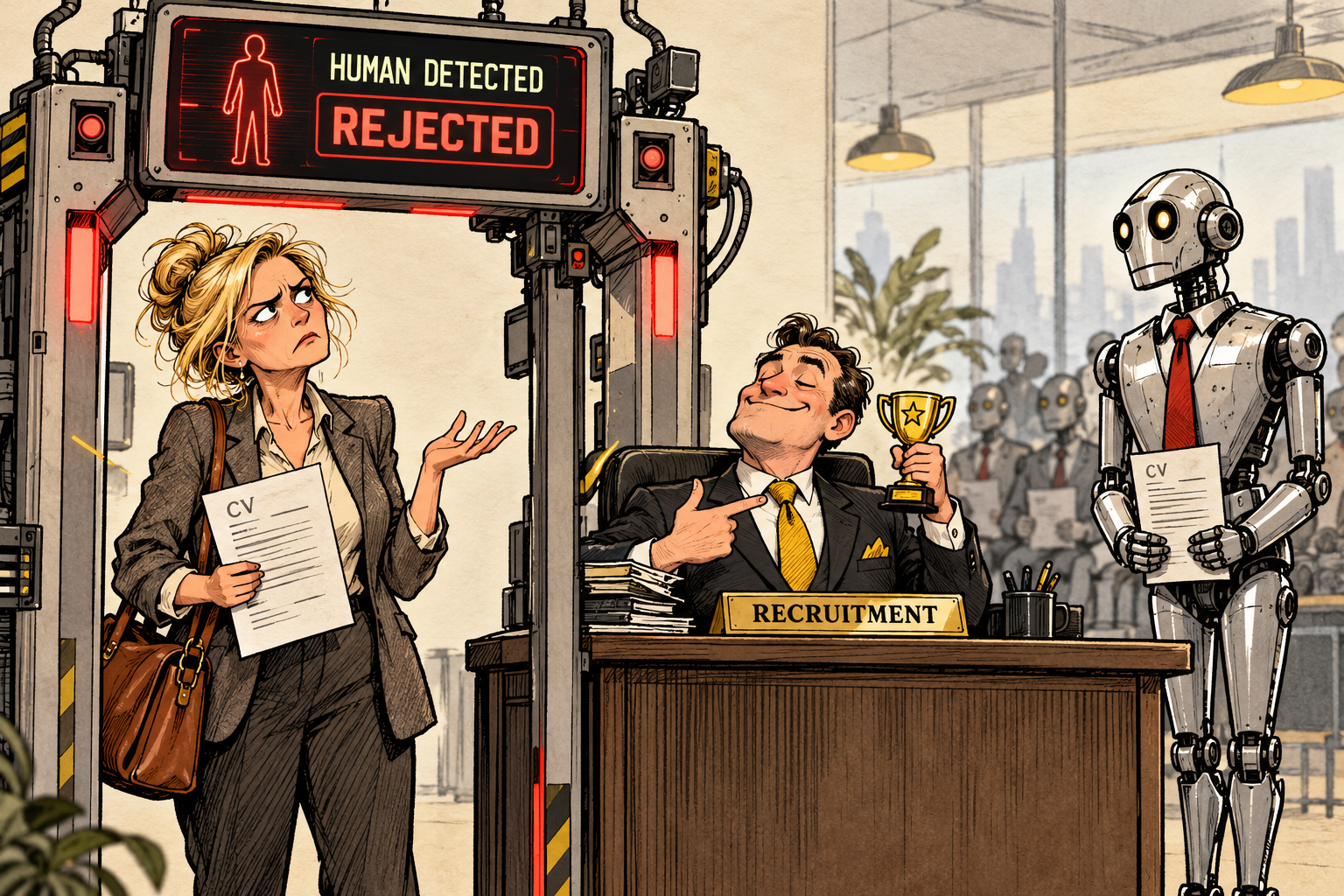
Welcome back to the Corporate Hunger Games, where securing employment now apparently requires proving that you aren’t three algorithms in a trench coat.
There’s a particular kind of recruiter post appearing in my LinkedIn feed lately. Triumphant. Self-congratulatory. Practically holding up a severed webcam.
Another fake candidate caught.
Another victory for recruitment.
Another opportunity to explain how sophisticated detection tools spotted “warning signals” such as AI-assisted activity, identity inconsistencies, manipulated faces, cloned voices, off-screen assistance and potential proxy interview patterns.
Meanwhile, I’m sitting here with one very basic question.
Who is creating these fake candidates? And why?
Is the dishwasher looking for a promotion?
Have the robots already started applying for work?
Is my dishwasher interviewing for Head of Operations because it has extensive experience managing cycles under pressure?
Has the printer put “excellent communication skills” on its CV despite spending the last decade refusing to explain what the fuck is wrong with it?
I would genuinely like someone to explain the endgame behind a fake applicant.
Who turns up after the imaginary person gets hired? Who does the work? Who receives the salary? At what point does someone notice that their new colleague’s face needs a software update?
I can imagine deception having a purpose. What I’m missing in these celebratory posts is an explanation of what actually happened.
What was the attempted fraud? What evidence confirmed it? Was someone impersonating another person, outsourcing their interview, or simply behaving in a way the software found suspicious?
Those seem like fairly relevant details before we bring out the recruitment confetti.
Your face has failed the assessment
Then there are the guardrails.
A reassuring word. Guardrails keep you safe. Prevent accidents. Stop you driving off a cliff.
Unless you happen to be the perfectly legitimate applicant standing on the wrong side of one.
How does a detection tool distinguish off-screen assistance from someone looking at their notes?
How does it distinguish suspicious behaviour from interview anxiety?
What happens when someone uses accessibility software, has an unreliable connection, or looks away because remembering an example from twenty years of work occasionally requires consulting the ceiling?
I’d like to know how those situations are handled.
Because being human is a deeply inconsistent activity.
We pause. We stumble. We forget things. Our voices change when we’re nervous. Sometimes our faces do strange things because the interviewer has just asked us to describe our greatest weakness without mentioning the recruitment process.
None of that should automatically become evidence for the prosecution.
Please appeal to the void
Suppose a real candidate gets flagged.
What happens next?
Does somebody review the evidence? Is the candidate told what raised the concern? Can they explain it? Is there an appeal process involving an actual person?
Or does the whole thing disappear into that familiar administrative black hole:
“After careful consideration, we have decided to move forward with other candidates.”
Careful consideration is doing a remarkable amount of unpaid work in recruitment emails.
It can apparently cover everything from a thoughtful assessment of your experience to a machine deciding that your left eyebrow looks outsourced.
And the applicant may never know the difference.
The recruiter gets a trophy. The candidate gets a template.
That’s the part that bothers me about the victory posts.
The recruiter gets a public success story. The software gets a glowing endorsement. The candidate gets labelled fake.
Where is the follow-up about how that conclusion was checked?
Where are the posts saying: “Our system flagged someone, we investigated, and it turned out they were a legitimate applicant”?
I’d find that considerably more reassuring. It would show that somebody understands the difference between a warning signal and a verdict.
Preventing fraud makes sense. But buying a detection tool doesn’t remove the responsibility to question its output.
Especially when the consequences land on someone trying to earn a living.
So before we applaud another fake candidate caught, perhaps we could ask one small question:
How did you establish that they were actually fake?
Some of us are already struggling to prove we’re employable.
Having to prove we exist feels like an unnecessary additional interview round.
May the odds be ever in your favour.
And may your webcam never render you suspiciously.